Friday, 29 January 2021

OUR CAMPAIGNS


FAWU has, since its inception and as a progressive workers' organisation, always campaigned for the advancement of the working class in terms of improved working and socio-economic conditions. Our campaigns therefore include:

The demand for a decent living national minimum wage of R 4500;

  • We support campaigns for better service delivery and meaningful engagement with government on policy decisions affecting our members, especially vulnerable workers  and the workers’ class in general.
  • FAWU, as an affiliate of SAFTU, or in partnership with civil society formations, campaigns against lack of access to affordable, quality food and food security;
  • It promotes and support programmes that will tackle the triple threat of poverty, unemployment and inequality in South Africa;
  • FAWU actively opposes the dumping of poultry and other job-destroying products and actions from foreign countries;
  • FAWU condemns illicit trade of food products and tobacco that undermines  legal industries and leads to job losses and  reduced government revenue;
  • We reject inappropriate and harmful policies and laws e.g. sugar tax, tobacco law, Liquor Bill, Fisheries Rights Allocations as these will result in job losses;
  • We oppose monetary policies obsessed with inflation targeting rather than economic growth and job creation;
  • We fully support fiscal policy that lead to higher taxation for the rich in favour of higher government revenue to support social grants and other social services.

Friday, 22 January 2021


ALCOHOL BAN SHOULD NOT LEAVE  WORKERS TO SUFFER 

22 JANUARY 2021


The Food and Allied Workers Union notes with a high level of discontent how the government treats the alcohol sector unfairly in the process of wanting to curb the spread of corona virus.


The government continues to ban and unban alcohol as and when it decides without consulting affected stakeholders and without expressing any position on the fact that workers are going to lose jobs while the alcohol ban is in effect and without expressing any position regarding the informal traders who also survive through selling alcohol in townships and rural areas.

The government should not view its decision of banning alcohol as the ultimate solution in the process of curbing the spread of corona virus. Authorities must find ways to mitigate the negative implications of its decision to implement a ban and not leave workers to suffer alone.


Notwithstanding that some of our members had to endure a 10% salary cut while others were being retrenched in the earlier alcohol ban, this current ban has already led employers taking initiatives that threaten jobs such as retrenchment of workers in the brewing companies.

When government does not consider the dangerously high number of unemployed people by making decisions that threaten and leads to job losses, it goes to show that the country will ultimately end up having more than the 10.8 million currently unemployed citizens through the growing number of retrenchments we have seen and continuing since the beginning of COVID-19.


Furthermore, the President of the country committed to address harassment in the workplaces. While we support addressing harassment, there are other critical challenges facing the workers’ class such as a growing list of proposed and current retrenchment. Had the government consulted the affected Unions, he would have been aware of the crisis instead of deciding for workers which problems should be addressed. What good does it do to address harassment against workers who are exiting employment in the thousands while the President continues to remain mum about job losses. By now, the government should have already shared the outcome of the International Labour Conference particularly those that relates to initiatives to formulate and enforce law regarding GBV in workplaces.   


Not all multinational businesses suffer in the same way as workers and small alcohol traders do, because they are not on equal footing to start with. For this reason, the government must never forget its mandate to favour those who are at the receiving end in terms of inequalities. In fact, vulnerable farm workers in the agriculture and agro-processing are more likely to be subjected to unemployment, which contradicts the very same mandate of creating jobs in the country. Yet there is a deafening silence about job losses.

For many years, we have informed the government about where funds should be sourced for purposes of addressing the fiscus deficit which includes illicit cash outflows that led to the country losing about R140 billion per annum. In 2016, the South African Revenue Service already lost over 3.8% of its revenue through companies that falsified their invoices. Last year alone, illicit trading in alcohol led to a loss of over R6 billion and in other sectors, counterfeit goods of about R1 billion per annum, including corruption that amounts to over R500 billion. The shortages of beds in the health care facilities indicates that banning alcohol was not the ultimate solution but addressing all the above unlawful activities including to nationalise the entire health care system would mitigate all other adverse impact to affected workers and in the informal economy. 

We believe that these billions combined would not only have addressed and mitigated the deficit on the government spending, but would also have proven that there was no necessity for the country to embark on structural reforms and source loans from international banks. These actions weakens the country’s economy while subjecting SA into a more non-progressive ideological stance of neoliberal agenda.

The state must also take into account that it is ultimately the responsibility of law enforcement agencies to address the behaviour that lead to violence, violating regulations, corruption and most importantly, to apprehend all those who commit gender based violence and not to focus solely on the alcohol ban as an ultimate answer.

In fact, one of the calls that the South African government have been neglecting while other countries have not been shy to embark on is the introduction of wealth tax that can contribute to lessen inequalities and increase fiscus up to over 9 billion. This government preferred to focus and implement VAT to 15%, which is a regressive tax, and evidently up until now, could not address the national crisis of poverty, inequalities and unemployment. 

FAWU DEMANDS THE FOLLOWING FROM EMPLOYERS AND GOVERNMENT:


▪         The government to meet with FAWU and all affected stakeholders in the alcohol sector;

▪         Government should in the interim formulate a funding package designed to assist workers in the alcohol industry and for the informal economy;

▪         Employers to redirect their reserved funds to preserve existing jobs;

▪         All retrenched workers to be given first preference to return back to work in employment;

▪         Government should issue a moratorium on retrenchments, job cut, salary cut and benefits cuts;

▪         The government to address outstanding and continue to pay UIF payments during shutdown of alcohol. 

▪         The government to announce the figure recovered by corruption on UIF and redirect those funds to workers; 

▪         The government to implement National Health Insurance;

▪         The government to implement Wealth tax;

▪         Nationalisation of all strategic sectors of our economy;   

▪         The government must publicly announce funds that were recovered from illicit trading in the country, if any.


Meanwhile we support all decisions to curb the spread of the virus, but the government must listen to the people who suffer amid COVID-19. Therefore, FAWU calls on the government to urgently, meet with all affected stakeholders in the alcohol industry.    

 For more information please call FAWU General Secretary Mayoyo Mngomezulu on 082 440 4039 mngomezulu.mayoyo@fawu.org.za  or Deputy General Secretary Vuka Chonco on 082 499 5854. Released by FAWU media liaison officer Dominique Martin 082 498 5631


Wednesday, 25 November 2020

FAWU SUPPORTS 16 DAYS OF ACTIVISM & CONDEMNS VIOLENCE AGAINST WOMEN AND CHILDREN


Media Statement - 25 November 2020

FAWU Supports 16 Days of Activism And Condemns Violence Against Women and Children


The Food and Allied Workers’ Union strongly condemns any form of gender based violence against women and children in South Africa. Sadly, these atrocious deeds have increased in our societies despite the loud public outcry over the last several years and the good work being done by several organisations across the country.


With the advent of 16 Days of Of No Violence Against Women and Children, we call on government and civil –society organisations to do even more to protect our women and children. Our communities are suffering because women and children have become the targets of deranged criminal minds’ instead of being protected and nurtured like they deserve to be.


It is no good to be living in a democratic society if our women and children cannot live and move freely in it. We simply cannot idly sit by and quietly watch how the vulnerable are being slaughtered often by those who they know as well as perpetrators who prey on those that cannot defend themselves.


In our work recruiting and servicing farm workers, we often see cases of gender-based violence play out amongst farming communities where women find themselves in an isolated area and as a result cannot access safe houses for victims of abuse. They are often too afraid to speak out as they fear further victimisation and the fear of being shamed by others. The patriarchal nature and the dependency of women on the male figure as the head of the household in farming communities adds to the marginalisation of victims of gender-based violence . FAWU calls on government to act decisively and to conduct specific GBV –awareness programmes specifically for women on farms, factories and rural communities so that they know there is help available should they be in need thereof. The union will also engage in awareness campaigns amongst our members.


We need to speak up for those who are unable to and we need to fight this scourge as a community who refuses to tolerate GBV and are willing to act against it. Gender –based violence is everywhere and it is our duty to call it out when we witness it. All too often in our communities, even in urban areas, we tend to look the other way instead of being the helping hand and the support structure that GBV victims need. Gender-based violence is a societal problem and unless we, as a whole,  address it as such , it is not going to go away.


For Help: Contact SAPS 10111 or Gender based violence Emergency Line 0800 428 428 or STOP Gender Violence Helpline 0800 150 15 or Send a “please call me” to *120* 7867# supported by a USSD.

Released by FAWU media officer, Dominique Martin- 082 498 5631

Thursday, 20 August 2020

FAWU CAUTIOUSLY WELCOMES LIFTING OF RESTRICTIONS ON ALCOHOL, TOBACCO & HOSPITALITY INDUSTRY


The Food and Allied Workers Union cautiously welcomes the announcement of lockdown Level two as announced by President Ramaphosa a week ago. We hope that the return to some form of semi-normalcy, shall pave the way towards economic recovery after previous lockdown levels that contributed to devastating effects on the tobacco, alcohol, hospitality and numerous other sectors of our economy. Most importantly the safety of our members on their return in workplaces.

As the largest trade union providing a service in the agricultural and alcohol sector, we are particularly concerned about our members and workers in these industries who have been at the receiving end of the negative effects of COVID-19. Many employees in the agricultural sector could not have access to income, especially those vulnerable farm workers on the wine estates who have experienced a total shutdown of normal operations.  Many employed in these affected industries have suffered loss of income; reduced working hours, benefits and retrenchments after the sector incurred severe economic distress and devastation during the initial lockdown regulations.  Some businesses have since postponed or cancelled investment initiatives and various other business opportunities which would have otherwise contributed to job creation. It is clear that the devastation is vast and incalculable at this stage. FAWU is already battling with numerous complaints from our members because of the negative effects that these bans had in these sectors.

With the lift of the bans on alcohol, tobacco we hope that this also assist the hospitality industry which has been in a non-contributing position into the economy and which shall desperately be in need of a recovery plan. We are hopeful that these “broken’ industries will be revived now that some form of semi-normalcy under lock down level two has returned. We anticipate a long and slow process to rebuild what we had prior to COVID-19.

The focus however should not only be  on the return and rebuilding of these sectors but the protection of workers in workplaces and to know companies that violated regulations by not paying workers since the beginning of the lockdown while accessing funds from government.

On a broader scale, over the last couple of years, FAWU consistently demanded that the National Treasury should be in cooperation with SARS and build its capacity in order to be able to prosecute and arrest illegal traders of tobacco and other products who have flourished during previous levels of lock down. Even up until today, we have not heard a single inclusive response from the authorities on their future endeavours in this regard. The country can no longer afford to loose out on the billions in revenue that could assist in trying to mitigate the heavy economic destruction brought on by COVID-19, which became an opportunity for illicit traders.

We do however hope that the government, in future, will consult the relevant stakeholders before shutting down whole industries and blindsiding important role players who have had to face numerous unforeseen consequences as a result.

Since the start of the lock down, FAWU demanded that any approach dealing with COVID-19 must prioritise the lives of workers from the beginning of the lock-down. We demanded it even back then from businesses operating at the time-  such as retailers, tobacco on export driven products, pharmaceutical companies, and in all the health care facilities -that the health and safety of workers must be prioritised before profit.

FAWU has already lost two of its members in the tobacco sector while others were hospitalised. Over 18 members tested positive in a single plant. This goes to show how our members are at risk while at work and if their safety is not taken serious to advance measures to curb the spread of corona virus; more members may lose their lives.  

We are further fully aware of the economic impairment that has been inflicted by the non-operations of many sectors in our economy. Notwithstanding that the government is silent on the recovery plan of which on its own is deafening. This period however should serve as a strong warning to the ruling party, particularly from an economic policy perspective, that the return should not follow the old policy patterns. It is clear that such policies not only failed, but could not respond to the national question crisis of unemployment, poverty and inequality. Furthermore, they also could not respond to COVID-19 pandemic. It is even worse that the pandemic has not ended and as such, the country still need a decisive policy review. 

Amidst other policy challenges, it becomes an immediate necessity for government to simply implement the NHI rather than to shift the blame to shortages of beds in hospitals. This will not only address the shortage of beds but the discriminatory approach of medical attention between the rich and the poor and many issues faced by health care workers in the sector.

It is important for the government to also implement wealth tax in order to deal with the gap between the rich and lowest paid in the context of wealth redistribution than this to remain in an indefinite conceptual stage.

Despite the economic recovery necessitated by COVID-19, the country has worsened its economic challenges by approaching the IMF and World Bank. This approach does not only subject the country into even deeper debt that will largely be an extra burden to the working class, but advances a neo-liberal agenda that is not in line with progressive economic policies the workers mandated the government to follow. We believe that the country is indeed capable to build its capacity in terms of economic recovery, as it is not in a dire situation on industrial development. Should the government disregard the policy issue; the country will remain as it were before COVID-19 era and possibly, even worse off.

While we welcome the unbanning of alcohol and related products, we are cautious about the return to work of many ordinary citizens who were not able to make a living with the ban in effect during lockdown. These poor citizens suffered more than large corporates and the return on their part shall be the beginning of a struggle to be in business again. This part of the economy has had devastating effects as it has been taken over by illicit traders.  Most legitimate alcohol and tobacco small entities/ traders shall find it extremely difficult to effect a shift from the illicit traders who enjoyed unfair trading during the ban of tobacco and alcohol towards a reasonable market share in their segment. It is important for the government to realise the adverse impact this has caused and, therefore, a return is not the ultimate solution. 

FAWU Demands the following from Employers and Government: 

  • Employers to ensure health and safety for all workers returning to work;
  • All retrenched workers to be brought back to work on all job openings or companies in complete operation;
  • The government to announce the number of all additional Labour inspectors employed and expose the companies that violated Health & Safety in workplaces, including the access of funds from government without paying workers; 
  • The government must formulate an economic recovery plan for the informal sector for it to be able go back its normal operation;
  • The government to implement National Health Insurance;
  • The government to implement Wealth tax;
  • The nationalisation of all strategic sectors of our economy;
  • The government to come up with a comprehensive multi-discipline program to address illicit trading in the country. 


We hope state authorities will not disregard all these demands and hope to have business as usual because there will be no sustainability in these sectors, let alone their contribution towards economic growth in the country.

For more information, contact FAWU General Secretary Mngomezulu Mayoyo on 082 440 4039. 

Sunday, 9 August 2020

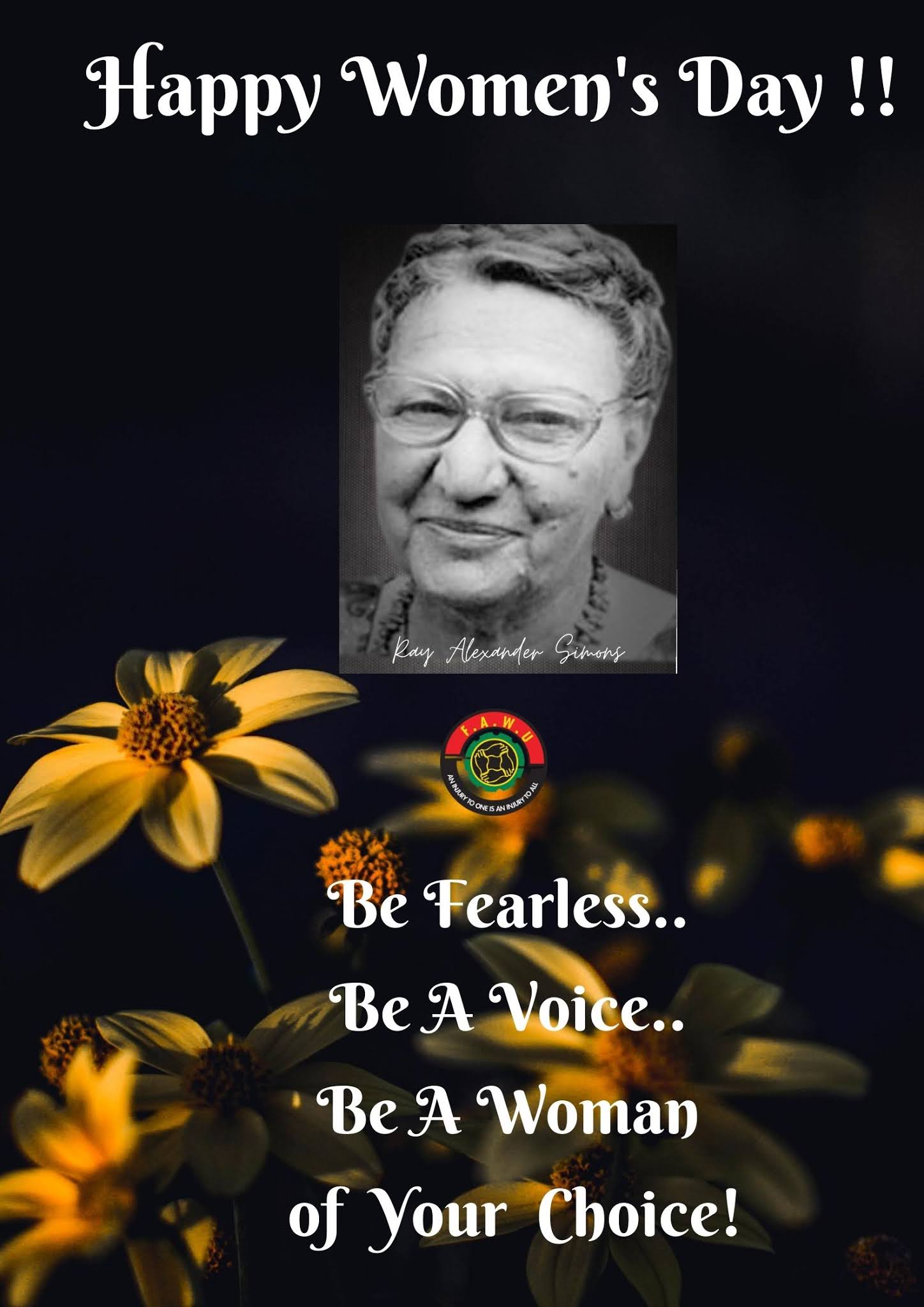
FAWU Salutes All Women On National Womens Day!


FAWU Wishes Women A Phenomenal National Women’s Day


The Food and Allied Workers’ Union extends its warmest wishes to all the women comrades in the workers’ movement on this National Women’s Day 2020 in the midst of an ongoing COVID pandemic on a scale we have never witnessed before.


Despite the current challenges we are facing as a result of the raging COVID-19 pandemic, our women, especially those very brave ones at the frontline of the pandemic such as our female food and health workers continue to perform their duties amidst fears of contracting the virus and fears for their loved ones. FAWU acknowledges and salutes the sacrifices and the outstanding brave acts of these and all our women who continue to selflessly provide and take care of their loved ones and all those requiring their care.

We are inspired that FAWU’s foundations were laid by fierce and committed anti-apartheid female struggle stalwarts such as Ray Alexander, Elizabeth “Rocky Mafikeng”, Elizabeth “Nanna” Abrahams, and Frances Baard who has often sacrificed their personal life to organise and recruit workers, especially women in rural areas who are often the most vulnerable due to patriarchal norms and gender inequality.  


We strive to emulate the total devotion to the workers class and its challenges that these special women worker leaders have shown.  Although we have made massive strides in terms of equal pay and equal treatment under the eyes of the law, we are still experiencing different kinds of challenges at the workplace and in our communities.  Here, we also bow our heads in remembrance of those women and girls who have lost their loves due to gender-based violence and we vow to do all we can in FAWU to fight this ongoing evil in our midst.

FAWU encourages our women workers leaders and staff to raise your voice and demand to be heard whether in your communities or on the factory floor.  When we speak and act as one, we are stronger together. The very foundations of society lies within the power of women to work collectively to achieve a brighter future for their children and for generations to come. As the saying goes, “When you strike a woman, you strike a rock!”

We pay tribute to the many good women who have sadly lost their lives or battling with the COVID-19 in their lives.  We hope that there may be speedy recoveries for those who are ill and that those who have lost loves ones find peace, healing and comfort.

To All Our Phenomenal Women Worker Leaders, members and staff in FAWU, We Salute You!

Enjoy Women’s Day!

Released by FAWU media officer, Dominique Martin 082 498 5631 obo FAWU General Secretary Mngomezulu Mayoyo 082 440 4039

Thursday, 6 August 2020

FAWU PAYS TRIBUTE TO A FALLEN COMRADE , KZN ORGANISER CDE TEMBA MQADI

6 August 2020

FAWU Solemnly Mourns Fellow Cde Temba Mqadi..


It is with profound shock and sadness that FAWU has learnt of the passing of our beloved union organiser Themba Mqadi from Kwa-Zulu Natal province on Thursday, 30 July 2020. Comrade Mqadi fell ill two weeks ago and was hospitalised on Saturday, 25 July 2020.

Comrade Mqadi was like no other official. His humbleness, dedication and passion for his work and the exceptional love for FAWU members in the merchandising sector made him a much- loved comrade.

His unwaivering commitment and selfless dedication to recruit members saw him being employed in a contract position in 2010. He often met with merchandisers on Sundays in the union’s offices. By the time he was employed on a permanent basis in 2011, he had single-handedly recruited 4312 paid-up members, which was double the target he was given at the start of the recruitment process. Since becoming a permanent employee in 2011, Cde Mqadi never once took leave during the December shutdown or any other important holiday as you would have found him working flat out. Even during level 4 and 5 of the lockdown, the comrade was out there helping members as testament to his unwaivering commitment to the union and its members.


Cde Mqadi was working at Beacon Sweets and Chocolate until 1989 and was once the chair person of FAWU’s Thembeni branch for two terms and deputy chair person of COSATU Pine town local and of the REC( today called the PEC) of FAWU. Thereafter, he was employed by the Sales and Merchandising Specialists( SMS). He diligently continued with his militant approach and organised and recruited other merchandisers into FAWU. In 2003, he was dismissed unfairly and after fifteen months, he won his case and was reinstated with full benefits. This reinstatement inspired him to go out and recruit even more members in the rural towns of Kwa-Zulu Natal. Cde Mqadi was truly committed to the extent that he even used his own money at times for travelling and accommodation during recruitment processes.

In 2018, FAWU offered cde Mqadi the position of FAWU Provincial Recruitment Organiser, which he continued to do with distinction which is evident by the fact that he left us with verifications meetings and CCMA disputes in terms of Section 21 of the Labour Relations Act. Our comrades from the Kwa-Zulu Natal province will follow up these scheduled meetings to resume his outstanding work.

Comrade Mqadi sadly leaves behind his ex-wife and 6 kids within and outside the marriage. FAWU officials from the province has visited Cde Mqadi’s family yesterday and they confirmed that the funeral will be held on Thursday, 6 August 2020.

FAWU salutes Comrade Temba Mqadi for his hard work, total dedication to the workers’ struggle and the wonderful colleague and friend he was.

Cde Mqadi will sadly be missed by all in the province. May his dear soul rest in peace.


Long Live the Spirit of Comrade Mqadi, Long Live!!

Released by General Secretary Mngomezulu Mayoyo on behalf of FAWU National Office-bearers and all FAWU staff and members


Friday, 31 July 2020

FAWU Stands With Hospitality Workers

Fawu defends members retrenchments at Hilton Hotel, Cpt
 

FAWU Condemns Government’s Disregard For Hospitality Sector Workers


Food and Allied Workers’ Union condemns the government’s total disregard for workers employed in  the  liquor and hospitality sectors especially those on wine farms and in restaurants as they are mostly vulnerable workers who already struggle to survive on abhorrently low wages. The COVID-19 lock down had a disastrous effect on tourism which brought the industry to its knees. The recent ban on alcohol served a double blow to the hospitality industry as local restaurants depend on alcohol sales to a large extent.


The government is failing thousands of workers whose employers have duly payed their UIF funds but is still waiting on outstanding payments from the last two months. The level of frustration among the workers’ class are at an all-time high and we see how these frustrations manifest in different protest actions like we have seen in Cape Town in recent days.


The people voted the government into power believing that it will create and protect jobs and now the very same government is destroying jobs by instituting bans that did not take into account the exact devastation it is bound to cause. As trade unions, we fight tooth and nail to protect jobs but this reckless ban is a complete let down by a government that is supposed to serve its people.

Workers in the hospitality industry were already looking losing out on income when the shutdown was initiated in late March this year. They just started working again on 1 June trying to provide for their families just to be dealt another harsh blow. How will these poor workers recover from one hardship after another.


As a government that purportedly cares for its people and believes in “Ubuntu” it is unjustifiable that these bizarre bans brings certain sectors to its knees and destroy so many lives while taking the country backward. As a labour union that joined in the struggle for freedom and democracy in South Africa, we demand that government listen and consult with affected industries and labour unions involved in order to come up with a holistic approach. Government consulted with the education and taxi unions and it is thus mind-baffling why the agriculture and hospitality related sectors are being side lined especially since it is the backbone of the South African economy.

We want government to engage with the sectors to discuss mitigating measures to curb the astronomical job losses due to the ban on alcohol and other products. We are currently dealing with a flurry of retrenchments across the food and beverage sectors as a result of these bans. When people lose their jobs we all lose as a country.


FAWU Stands With Workers In the liquor and hospitality sector!